The Industrial Twin That Remembers: From Handover Model to Operating Memory
Most plant twins die at handover: accurate, admired, and slowly wrong. Here is what turns a brownfield model into operating memory that survives shutdowns, revamps, and staff turnover.
Every brownfield plant has two versions of itself. One lives in the handover model: clean, coordinated, and dated the day of commissioning. The other lives in the field: revamped twice, patched in places nobody drew, and operated by people who learned its quirks by walking it. An industrial twin earns its keep only when those two versions converge and stay converged, shutdown after shutdown.
Key takeaways
- Most plant twins die at handover: accurate on day one, silently wrong by year three. Survival means recording every shutdown change against persistent equipment tags.
- A twin must answer day-two questions: which exact asset alarmed, what depends on it, who may touch it, and whether the evidence is fresh enough to act on.
- Freshness follows risk. A live flare line demands current observation. A boundary wall tolerates last quarter. One twin, different clocks.
- Judge the twin by outcomes: flag-to-fix time, first-time fix rate, and whether the record proves the plant returned to its intended state.
Handover is where twins go to die
The handover ceremony flatters everyone. The model is complete, the documents indexed, the drive handed over with photographs. Then operations begin, and the plant starts doing what plants do. A shutdown replaces an exchanger bundle with a different footprint. A revamp reroutes two lines around a new skid. A contractor adds a tie-in on a night shift and sketches it on a print that never returns to the office.
None of this is negligence. It is industrial life. But each unrecorded change taxes the twin's credibility, and credibility spends fast. Within a few cycles, engineers learn the pattern: trust the model for orientation, verify everything in the field. At that point the twin is a viewer with a maintenance contract. The money moved, but the work still runs on boots, memory, and phone calls.
The acceptance question at handover should therefore change. Not whether all files were delivered, but whether an operating event can be traced from detection through intervention to verified restoration using the twin alone. Few handover packages pass that test today. Every section below exists to make the next one pass it.
One shutdown shows what the twin must hold
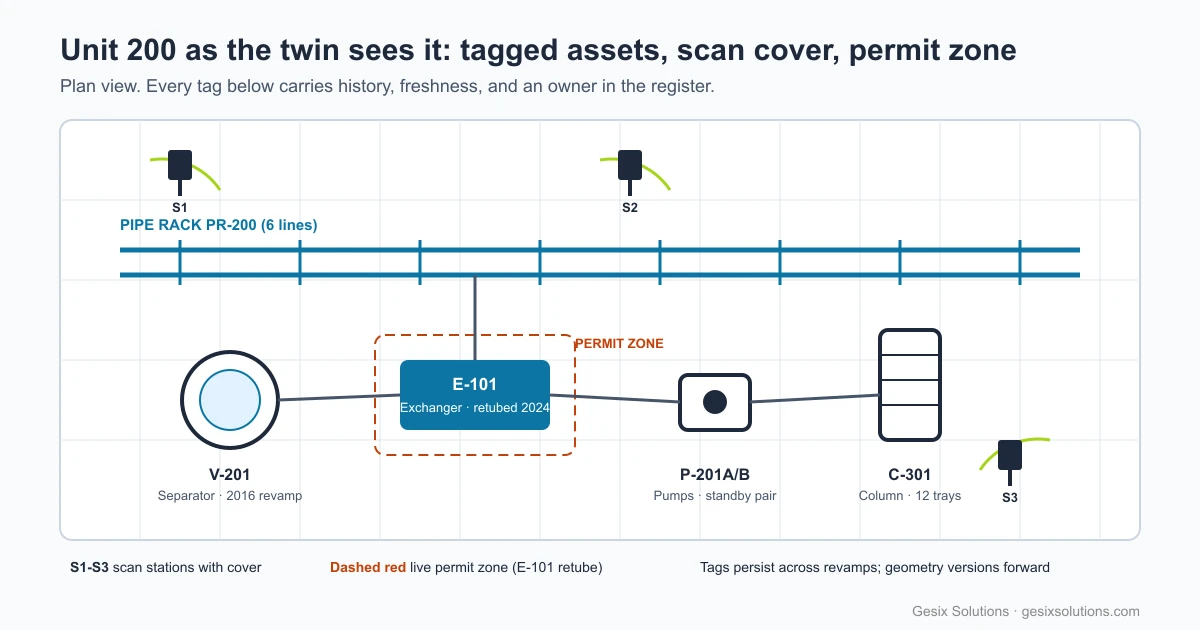
Take a routine turnaround job: retubing a heat exchanger in a ten-year-old process unit. The planner opens the twin and needs specific things, in order. Which exact tag is the exchanger, and which lines connect to it. Whether the P and ID line numbers match the field tags after two revamps. Which live lines run above the laydown area, and what the minimum approach is. Where scaffolding can stand without blocking the escape route. What the isolation valves are, and whether anyone has operated them since the last shutdown.
A conventional model answers the first item and gestures at the rest. A working twin answers all of them, because each answer lives attached to the asset: geometry from the last scan, tags from the registry, safety boundaries from the HAZOP actions, isolation history from the permit log. The difference between those two experiences is the difference between a model and an operating memory. Our digital twin development and industrial sector work are built around the second one.
Scan the truth, tag it for life
Brownfield capture starts from a hard rule: survey what exists, never what was designed. Terrestrial LiDAR at close range, registered on physical targets, reconciled to plant control. The point cloud that results is the only honest baseline a revamped plant has. Our 3D scanning and point-cloud standards notes cover the discipline: target-based registration, tight tolerances, QA gates before release.
Then comes the step most projects skip. Every modelled element gets a persistent equipment identity: tag number, P and ID line reference, system parent, safety boundary. Identity must outlive geometry, because geometry will change and the tag must not. When the exchanger gets replaced with a larger shell, the shell geometry versions forward while the tag, its history, and its permits stay put. A twin that treats the new shell as a stranger has amnesia. One that keeps the tag has memory, and memory is the product.
Freshness is a clock per asset, not per twin
Here is the question that kills static twins: when was this asset last observed, by what source, and is that recent enough for the decision in front of us. A boundary wall surveyed last quarter is fine. A flare-line support surveyed last quarter, after a monsoon of corrosion, is a guess wearing a model's clothes.
Here is the shape of that decay, and what recording buys back (illustrative pattern, not measured data):
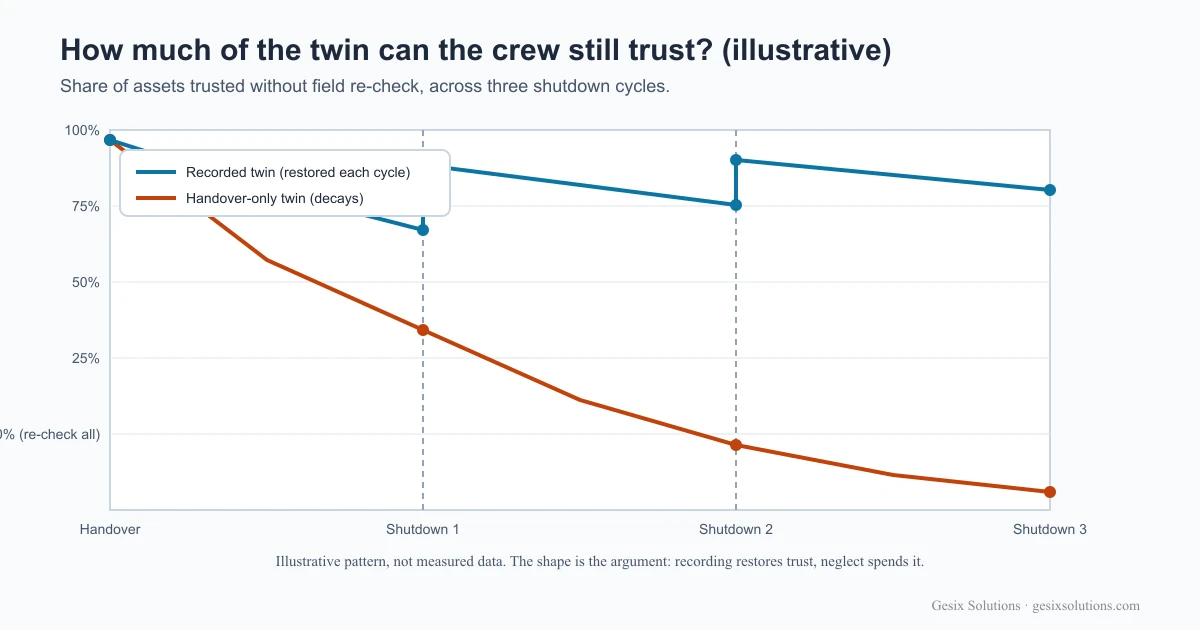
So each asset carries its own evidence date and its own required refresh rate, set by consequence. High-consequence, fast-changing assets re-verify every cycle. Slow, low-risk fabric re-verifies on schedule. Anything with no observation on record sits at UNKNOWN until surveyed, visibly marked, never silently trusted. The register shows the clock next to the reading, which means the first thing anyone asks the twin is also the first thing the twin answers: can you trust me on this one, today.
Assumed geometry is not observed reality
Brownfield plants accumulate three kinds of spatial information, and mixing them silently is how people get hurt. Observed reality comes from scanners, surveys, and inspections with dates attached. Modelled reality comes from design intent and simulation. Assumed reality comes from drawings nobody has verified since commissioning.
A permit decision must know which kind it stands on. Hot work above a line that exists in the design model but was rerouted in the last revamp is a different risk proposition than hot work above a line scanned last month. The twin must label the provenance of every claim it shows, which is why open delivery formats matter: an IFC handover with survey-derived origins and dated property sets carries its own audit trail, while a pretty mesh carries none.
Permits need the twin. The twin must not grant them
Spatial context earns its place in safety-critical work when it informs permits without pretending to issue them. A permit to scaffold near a live rack should open with the twin's answers: the rack's contents, the live lines within approach distance, the access constraints, the freshness of the survey behind each claim. Then the permit authority, a person with a signature, decides.
That boundary holds for AI as well. Detection models flag corrosion, misalignment, and missing insulation at 85-95% accuracy on trained classes in our operations, and every flag still routes through engineer confirmation before it becomes work. Recognition is not authorization. The twin supplies evidence with dates. People supply judgment with signatures. Plants that blur that line eventually learn why it exists.
What changes commercially
A handover twin is priced like a project: scoped, delivered, transferred. An operating twin is priced like infrastructure, because it participates in recurring decisions and its value compounds. The measures change accordingly: hours from flag to fix instead of model completeness percentages, first-time fix rates instead of object counts, avoided shutdown extensions instead of render quality. Each verified intervention feeds the record that makes the next one faster, which is the only flywheel that matters in this business. The twin that remembers pays for itself in the shutdowns it shortens and the surprises it cancels.
So the market question is not who renders the finest plant. It is whose twin still tells the truth in year five, after three turnarounds and a staff rotation. Ours is built for that test: scanned truth, persistent tags, freshness clocks, governed permits, and a record that grows with every job. Because an industrial twin is not a model of the plant as it was handed over. It is the plant's memory of everything since.
Frequently Asked Questions
Why do industrial digital twins fail after handover?
Because the plant keeps changing and the model does not. Every shutdown, revamp, and undocumented tie-in widens the gap between the handover geometry and reality, until engineers stop trusting the twin and go back to field verification for everything.
What is twin freshness and why does it matter?
Freshness is the age and provenance of the evidence behind each asset: when last observed, by which source, at what accuracy. A geometrically perfect six-month-old model can still be operationally unsafe if the area changed since. Freshness should follow risk, not a fixed calendar.
Should AI replace manual inspection in plant twins?
No. Detection models reach 85-95% accuracy on trained defect classes, measured against manually inspected references, but only inside their training distribution. The durable pattern is AI flags plus engineer confirmation, with high-consequence actions never auto-closing.
What should a good digital handover contain?
Beyond models and documents: consistent equipment tags, location hierarchies, system relationships, operating limits, procedures, and links to responsible parties. The acceptance test is whether an operating event can be traced from detection through intervention to verified restoration.
How does a twin support permit-to-work safety?
By tying the permit to the asset: its isolation points, live lines nearby, access constraints, and the freshness of the underlying survey. The twin answers what surrounds the job, while the permit system keeps the authority to approve it.